Updated 10-10-2026 · v2026.10
Where Europe’s rearmament is stuck.
An open intelligence map of Europe’s defense industrial base: 162 factories, 36 supply-chain bottlenecks and the links between them. Sourced, dated and free to use.
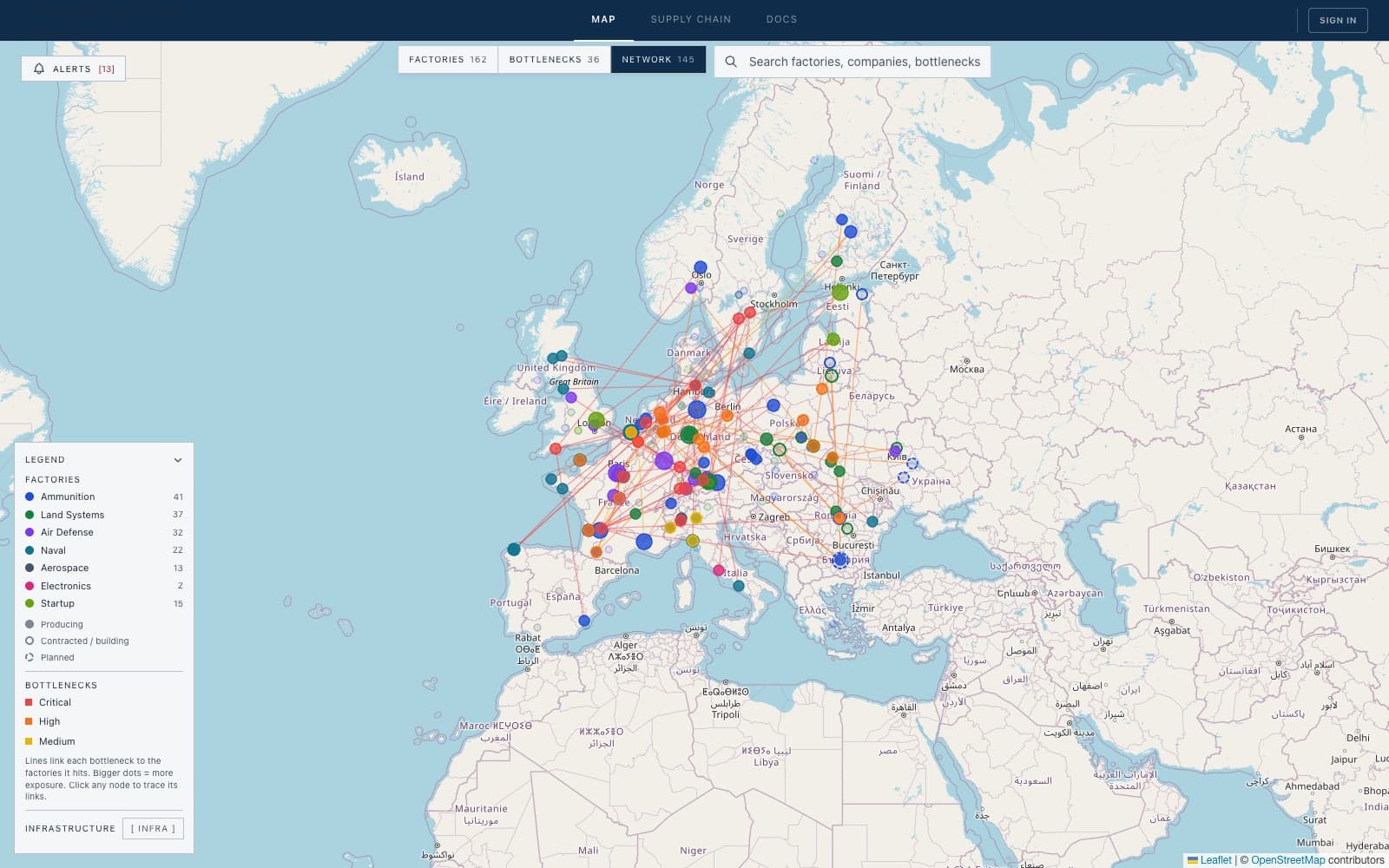 Network view · 145 links between bottlenecks and factoriesOpen
- Factories
- 162
- Countries
- 25
- Bottlenecks
- 36
- Factory links
- 145
- Programmes traced
- 35
- Live alerts
- 13
Three ways to read the map
From a single factory to the whole network of dependencies.
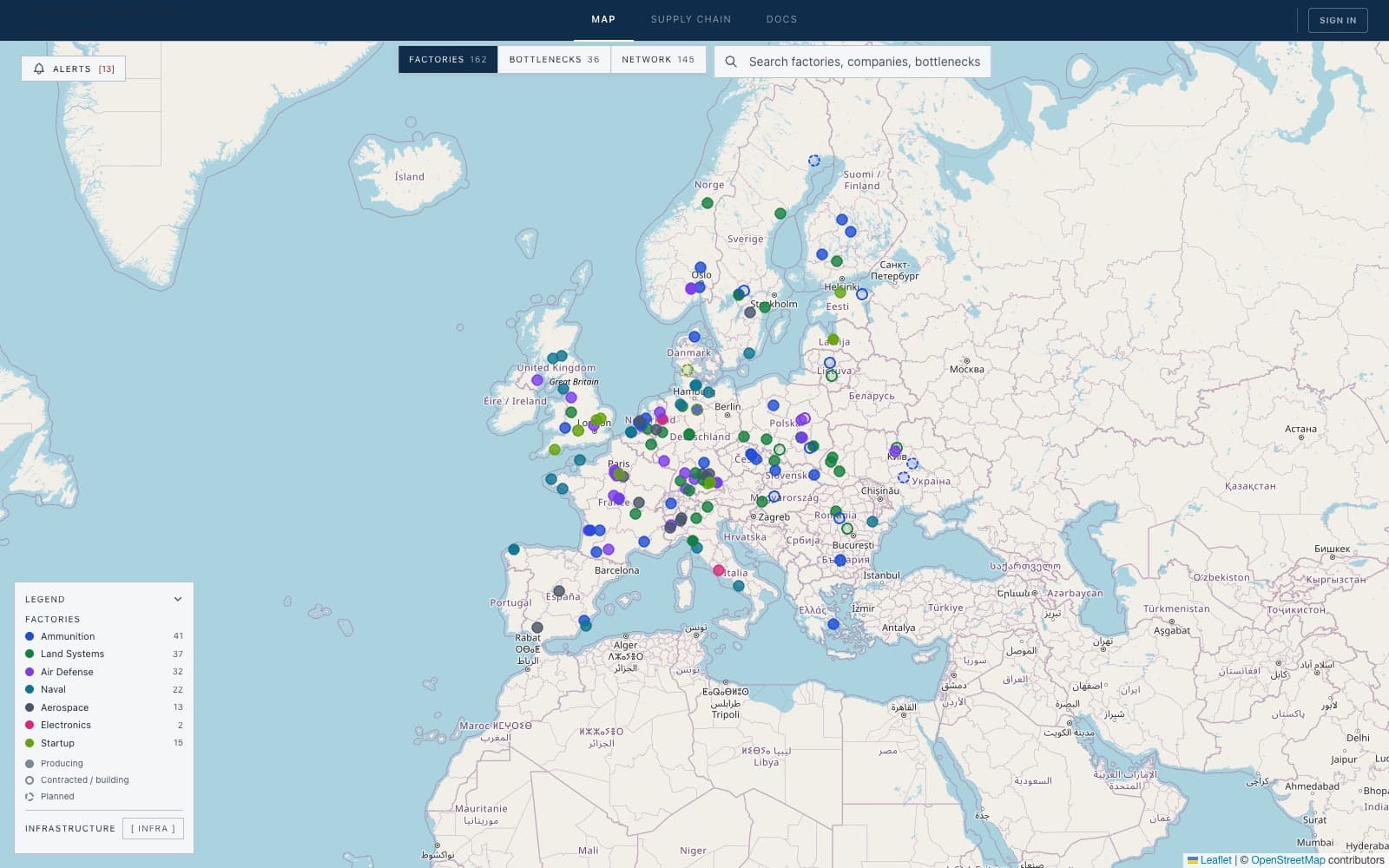
Factories
Every production site by category and status: producing, contracted, under construction or planned. Capacity, funding and sources for each.
Open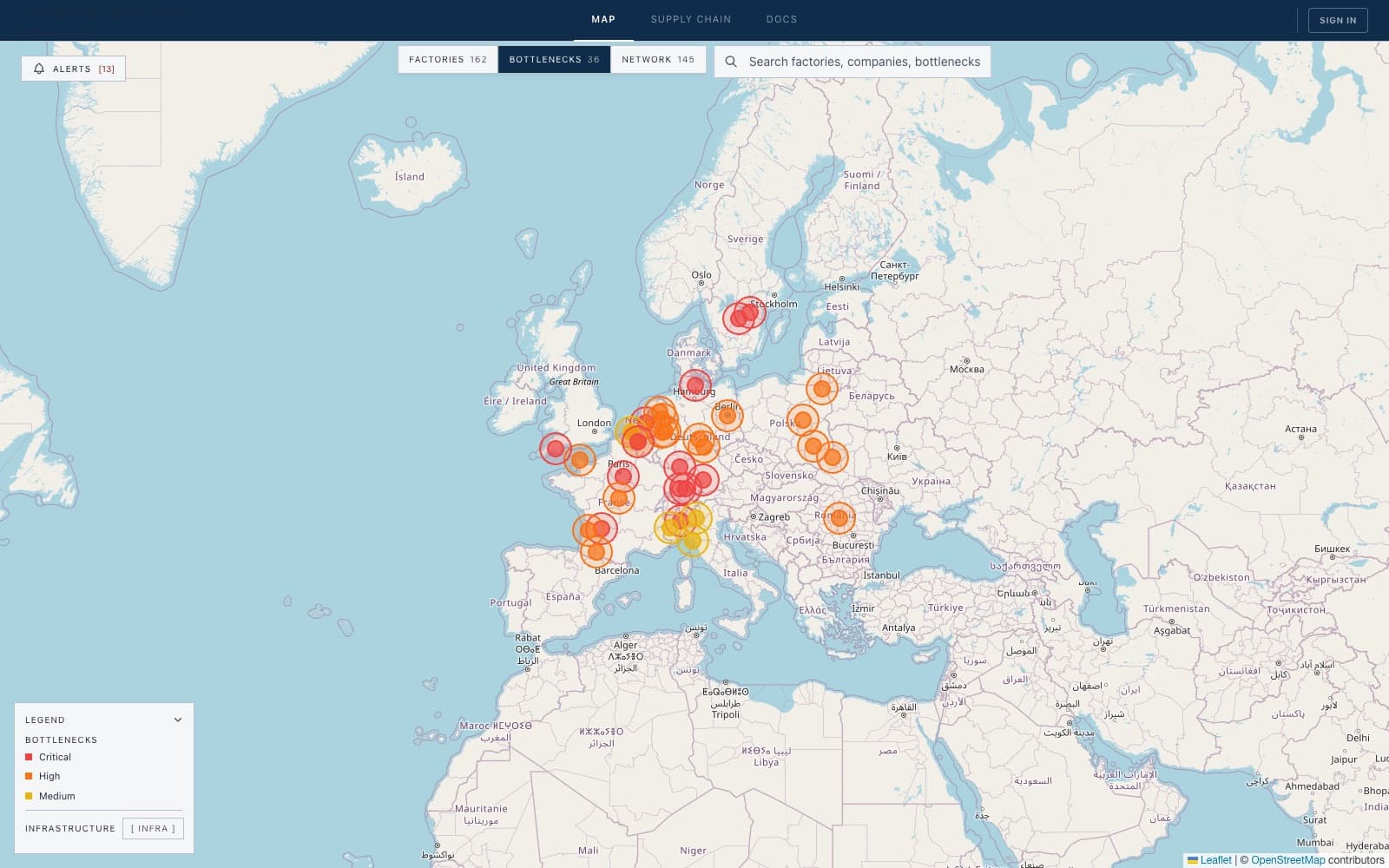
Bottlenecks
The structural constraints on European output, from propellant inputs and rare-earth magnets to interceptor production and skilled labour.
Open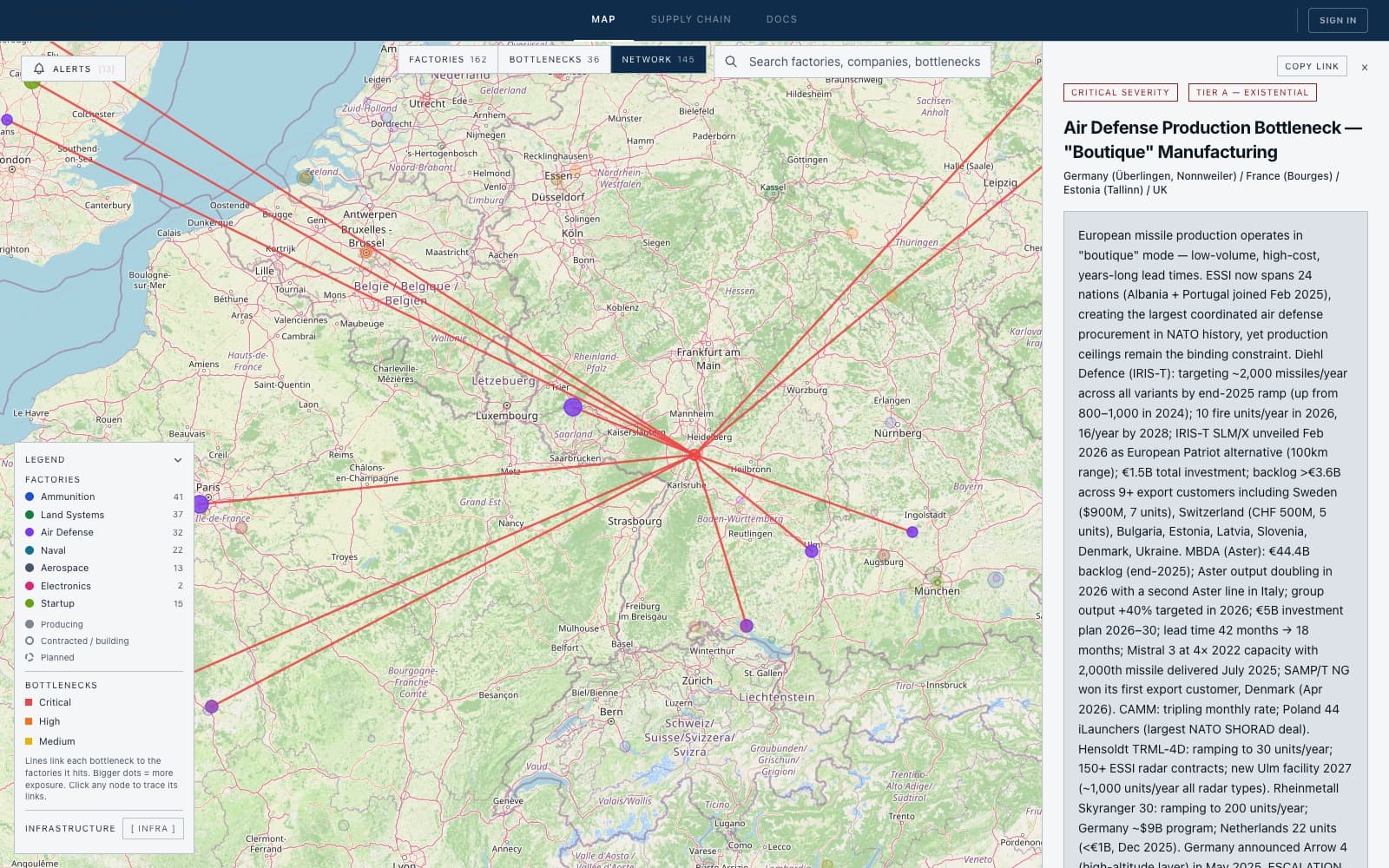
Network
Both together: each bottleneck linked to the factories it hits. Click any node to see how far one choke point ripples.
OpenLatest intelligence
What just changed.
- China REE/Magnet Controls — Guided Weapons & Drones Exposed; Suspensions Expire 10 & 27 Nov 2026critical · 09-10-2026
- F126 Frigate Cancelled — €2B+ Sunk Cost, €4.7B Damen Claimhigh · 01-10-2026
- SAFE €150bn: Only ~€11.9bn Disbursed (All Pre-Financing) by End-August 2026high · 25-09-2026
- Patriot Interceptor Stocks in Europe "Beyond Critical" — US Warns of Delivery Slips of up to 5 Yearscritical · 23-09-2026
In this update · v2026.10
- Nitrochemie Aschau — foundation laid 22 Jul 2026 for 1,700 → 4,200 t/yr powder, full capacity 2028
- Ammunition: Dezamet Nowa Dęba (PGZ-AMUNICJA PLN 13.5B, Poland 30k → 180k shells/yr), ARCA Kiviõli (EE), SWEBAL Nora TNT (SE), Hellenic Ammunition Lavrio (GR)
- Rheinmetall-VMZ Sopot — contracted → planned (Bulgarian review); Baisogala start slipped to early 2027
- MBDA Aster ~80–100/yr in 2025 (doubling in 2026, second line in Italy); Diehl IRIS-T ~800–1,000 missiles/yr; Rafale ~2/month (backlog 208)
- Air defence: COMLOG GEM-T Schrobenhausen, Rheinmetall/Lockheed ATACMS & rocket-motor centre Unterlüß, WZE Zielonka CAMM-ER, Thales Ditzingen GO12
Critical bottlenecks
The constraints that matter most, ranked.
The most severe bottlenecks, ordered by how many factories they hit. Each one shows who is mitigating it and where the unmet opportunity is.
Supply chain
From prime contractor to raw material.
Trace 35 major programmes, from Leopard 2 and IRIS-T to 155mm ammunition, down through subsystems, components and raw materials. See which single suppliers sit under many programmes at once, and how risk shifts toward 2030.
Explore supply chains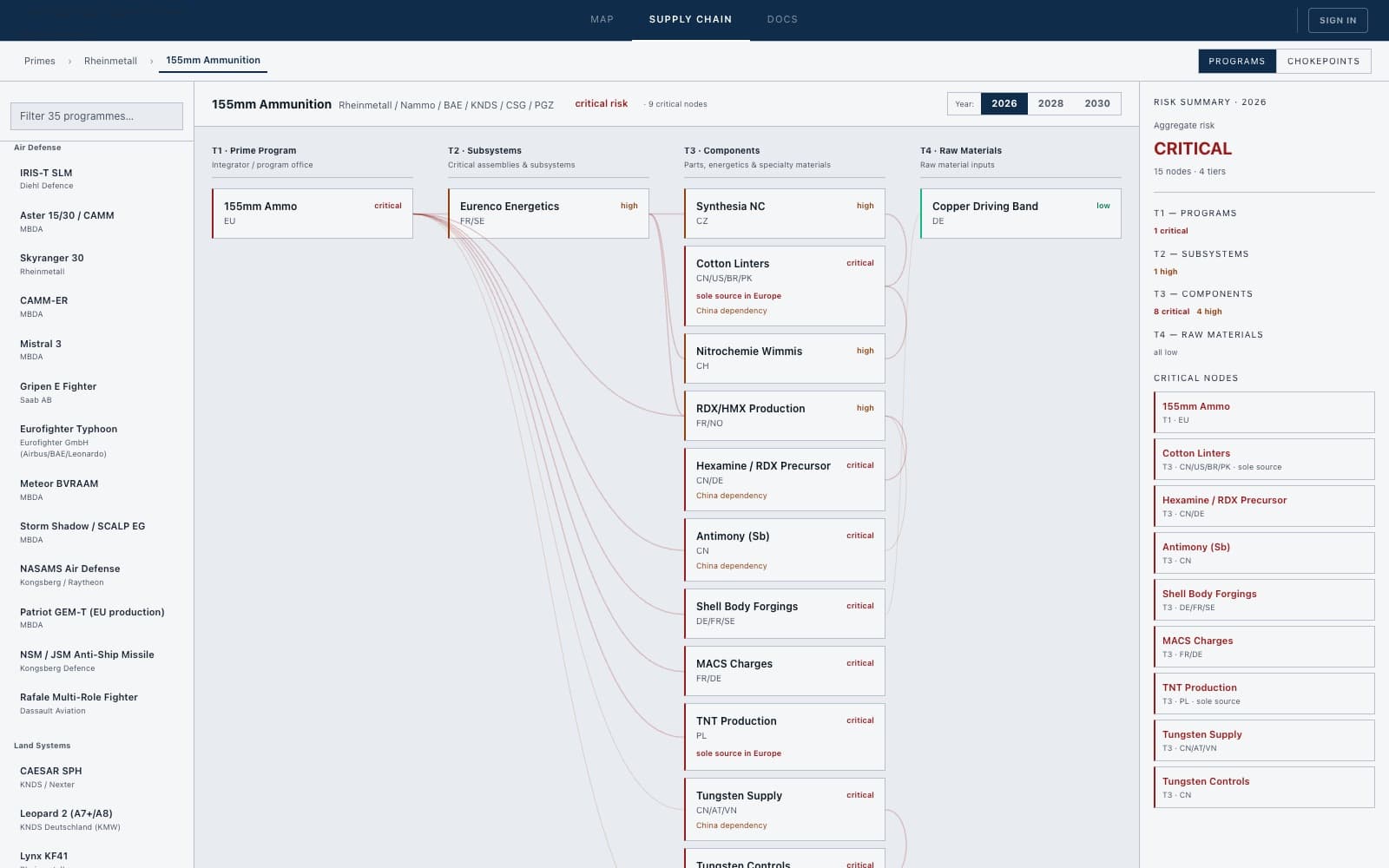
Who it’s for
Founders
Size your market on real constraints, find the primes and programmes that buy, and anchor your why-now in sourced data.
Investors
Map whitespace against ranked bottlenecks, test a startup’s positioning against production reality, and spot timing.
Industry & procurement
See single-source and non-allied dependencies across programmes, and which orders will stall on capacity.
Researchers & journalists
Sourced, dated facts with a shareable link for every factory and bottleneck. Free to use and cite.
Why this exists
I invest in European defense technology at Keen Venture Partners. This data didn’t exist in one usable place, so I built it and made it free. If it helps a founder find their market, an analyst sharpen a thesis or a ministry prioritise procurement, that’s the point.
Ties Klinkhamer
Building something that fixes one of these bottlenecks?
I’d like to hear from founders working on energetics, interceptors, magnets, chips and production tech.
Get in touch